Truck Chain Laws This Winter: When You Must Chain Up
Colorado and Washington make trucks carry chains all winter on mountain routes, whatever the weather. California and Oregon require chains when signs are posted, and snow tires do not replace them for heavy trucks. If you run the West between November and April, keep a full set of chains on board.
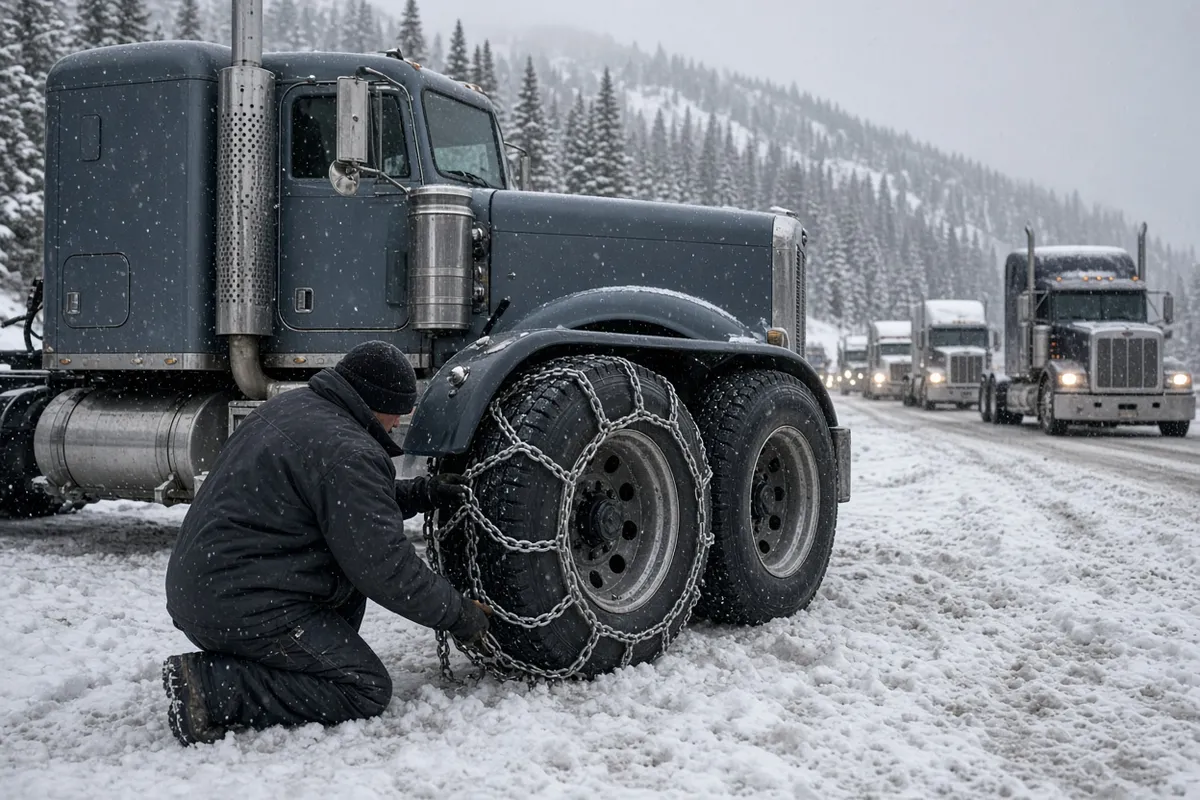
Chain laws are state laws, so the rules change at the state line. Some states make you carry chains all season. Others only care when a sign is lit. Below is what four western states say on their official pages, with links so you can check before you dispatch.
Chain laws by state
| State | When you must carry chains | When you must put them on | Penalty |
|---|---|---|---|
| Colorado | Sept. 1 – May 31 on listed mountain routes | When the Commercial Vehicle Chain Law is active | $500 for not carrying; up to $1,000 plus surcharge for blocking the road |
| Washington | Nov. 1 – April 1 on 12 listed routes, any weather | When “Chains required” is posted | Patrol can stop you from entering a chain area |
| California | No set season | When chain controls are posted | CHP citation and fine; trucks without chains are turned back |
| Oregon | When signs require it | When “Chains required” is posted | Class C traffic violation; class A for commercial drivers who fail to carry and use chains |
Colorado: the Must Carry Law
Since September 1, 2024, Colorado’s expanded law covers commercial vehicles with a GVWR or GCWR of 16,001 pounds or more. That includes RVs that heavy. From September 1 through May 31 you must carry chains or an approved alternative traction device on these routes, per CDOT:
- I-70 west of mile 259 (Morrison)
- CO-9 from mile 63 to 97 (Frisco to Fairplay)
- US-40 west of mile 256 (Empire)
- US-50 west of mile 225 (Salida)
- US-160 west of mile 304 (Walsenburg)
- US-285 west of mile 250 (Morrison)
- US-550 from mile 0 to 130
When the chain law is active, you need chains or approved devices on four drive tires, or on all drive tires if you have fewer than four. Trailers do not need chains. Clip-on chains are not allowed. While the law is active, trucks must stay in the right lane except to pass a stuck or slow vehicle.
CDOT says police wrote more than 1,300 Must Carry citations in the 2024–2025 season. There are 130 chain stations in the state, 22 of them on the I-70 mountain corridor (CDOT news release).
Washington: carry from November 1
On the routes listed by WSDOT, any vehicle over 10,000 pounds GVW must carry chains from November 1 to April 1, no matter the road conditions. The list includes I-90 from North Bend to Ellensburg, I-82 from Ellensburg to Selah, US-2 over Stevens Pass, US-12 over White Pass and SR-410 from Enumclaw to Naches.
You also need at least two extra chains on board in case conditions get worse or a chain breaks (WAC 204-24-050). Chains must have two sides and hardened metal cross chains. Plastic chains do not count. Local deliveries that stay outside chain areas and do not cross a pass are exempt.
California: what R1, R2 and R3 mean
California has no carry season. Chains are required when chain controls are posted. Any vehicle over 6,500 pounds gross must chain up at every level, and snow tires do not exempt heavy commercial vehicles (Caltrans).
The levels mostly matter for cars and pickups (Caltrans chain controls):
- R1: chains on all vehicles except cars and light trucks with snow tires on two drive wheels.
- R2: chains or traction devices on all vehicles except four-wheel or all-wheel drive with snow tires on all four wheels.
- R3: chains on every vehicle, no exceptions.
Caltrans says the R codes are for its own use. The signs on the road show the actual rule. For a semi, the answer is the same at R1, R2 or R3: chain up.
Chains go on the drive axle, the rear drive axle unless the truck maker says otherwise. When controls are posted on Donner Pass (I-80), link-type chains are required on at least the main drive axle. In bad weather, trucks may be stopped at checkpoints and turned back if they have no chains. Speed with chains is limited to 25 or 30 mph.
Oregon: chains, not traction tires
In Oregon, “Chains required” signs apply to vehicles over 10,000 pounds GVW and to anything towing. Trucks cannot use traction tires instead of chains (TripCheck).
Oregon’s minimum chain rules for a tractor pulling a semi-trailer:
- Single drive axle: two tires on each side of the drive axle, so four tires. The trailer also needs chains on one tire per side of any one axle.
- Tandem drive solo truck over 26,000 pounds: two tires on each side of the main drive axle.
On duals, you may chain the inside or the outside tire. ODOT can also close a road to some vehicle types in bad weather. I-5 over Siskiyou Pass is a common example.
How to chain up a semi
Each state posts diagrams of where chains go. Use Caltrans’ chain chart, Oregon’s minimum requirements and CDOT’s videos. The basics are the same everywhere:
- Pull into a chain station or a wide, flat spot off the travel lanes. Set the brakes and turn on your four-ways.
- Lay the chain out flat, with the hooks facing out, and drape it over the tire.
- Pull ahead a few feet so the chain sits under the tire. Hook the inside first, then the outside.
- Tighten with tensioners or bungees, drive a short distance, stop and tighten again.
- Take chains off as soon as the road is clear or the chain law is lifted.
Avoiding a jackknife on ice
Most jackknifes start with a sudden input: hard braking, a quick lane change or too much speed into a curve. On ice, slow down before the grade, not on it. Leave more room than you think you need. Use the engine brake with care, or not at all, on slick pavement. A light trailer slides easier than a loaded one.
If a state shuts a road to trucks, wait it out at a safe place. A missed appointment costs less than a wreck.
More road and weather news is in our Life on the Road section.
What it means for drivers
- Colorado: carry chains Sept. 1 to May 31 on I-70 west of Morrison and six other mountain routes. Not carrying can cost $500.
- Washington: carry chains Nov. 1 to April 1 on I-90 over Snoqualmie and 11 other routes, plus at least two spare chains.
- California and Oregon: chain up when signs say so. Heavy trucks cannot use snow tires in place of chains.
- Check 511 before the climb and chain up at a chain station, not on the shoulder of a grade.
Sources
- Caltrans: Chain requirements (trucks)Primary source
- Caltrans: Chain controls (R-1, R-2, R-3)Primary source
- CDOT Freight: Chain Up Tips and the Must Carry LawPrimary source
- CDOT: 1,400 miles, 130 chain stations: Colorado's Must Carry Law (Oct. 21, 2025)Primary source
- WSDOT: Chain requirements for vehicles over 10,000 poundsPrimary source
- Washington Administrative Code 204-24-050Primary source
- ODOT TripCheck: Oregon chain lawPrimary source
- ODOT TripCheck: Minimum chain requirementsPrimary source
Published